Why Is Crypto Crashing? The November 2026 Sell-Off Explained
Why is crypto crashing? A hawkish Fed, the record Binance hack and an AI stock sell-off hit within ten days, and leverage made each drop bigger.
 DegenKitNovember 7, 2026 · 7 min read

Crypto is crashing because several shocks hit within ten days: a hawkish Fed decision on October 28, the record Binance hack on October 29 and a tech-stock sell-off on November 5. Forced selling of leveraged positions and ETF outflows made each drop bigger. Figures below are as of November 5–7, 2026.
What happened, day by day?
- October 28. The Federal Reserve kept rates at 3.75%–4.00% in a 10–2 vote. The two dissenters, Governor Lisa Cook and Cleveland Fed President Beth Hammack, wanted a quarter-point hike. Chair Warsh called inflation "too high", according to Wolf Street.
- October 29. Attackers drained Binance hot wallets on 11 blockchains. Elliptic counts $6.43 billion stolen, the largest theft in history. Bitcoin fell below $79,000, and about $628 million was liquidated within an hour.
- November 3. Bitcoin briefly rose above $80,000 after the US midterm elections, then gave the gain back.
- November 5. The Nasdaq fell 5.5% and the S&P 500 fell 4.3% on doubts about AI infrastructure spending. Bitcoin fell 5.3%, Ether 7.2% and Solana 6.5%.
- November 6. South Korea's KOSPI closed 6% lower and Japan's Nikkei fell almost 6%. Ethereum developers delayed a planned upgrade on a test network.

Why did a few bad days turn into a crash?
Each event would have caused a dip on its own. Three things made the drops much bigger.
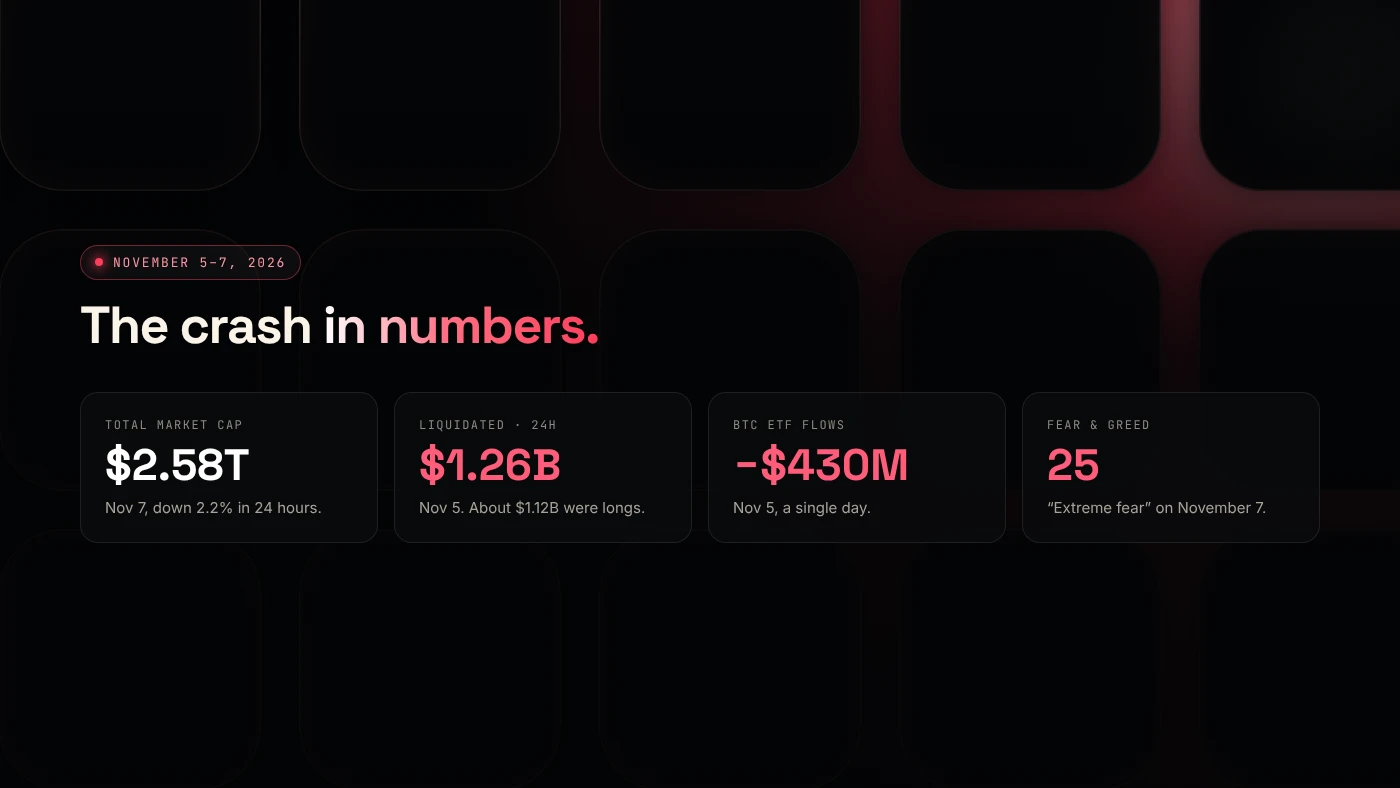
Leverage. Many traders borrow to make larger bets. When the price falls far enough, exchanges close those bets automatically and sell. That selling pushes the price lower and closes the next group of bets. About $1.26 billion was liquidated in the 24 hours around November 5, roughly $1.12 billion of it from traders betting on a rise (crypto.news). Our explainer on how crypto liquidations work shows the cycle step by step.
ETF outflows. Spot Bitcoin ETFs lost $430.2 million on November 5 and another $411.9 million the next session. Ether ETFs lost nearly $100 million on November 5.
Tech-stock correlation. When AI and chip stocks sold off, crypto was treated as one more risky asset and sold with them.
Where do Bitcoin, Ether and Solana stand now?
As of November 7, 2026:
- Bitcoin was near $76,000, roughly 40% below its October 2025 high. Read why Bitcoin is down.
- Ether was near $2,240, with $2,200 as the support level most analysts cite. Read why Ethereum is down.
- Solana closed November 5 near $89, almost exactly on its 200-day average. Read why Solana is down.
Bitcoin's share of the whole market was 59.3%. A high share usually means money is staying in Bitcoin rather than moving into smaller coins.
Will crypto recover?
No one can say when, and this post makes no prediction. Analysts are watching a few signals that would show selling pressure easing:
- ETF flows turning positive for several days in a row.
- Bitcoin holding the $75,000 area and closing back above $80,000.
- Open interest, the total size of open futures bets, falling. This means less leverage is left to unwind.
- Tech stocks steadying after the AI sell-off.
- The Fed sounding less hawkish at its next meeting.
The Binance situation also matters. About $2.85 billion of the stolen funds has been frozen or seized, and Binance said it will cover customer losses. Our explainer on the Binance hack covers what is still unresolved.
What does the crash mean for token creators?
A crash changes the conditions for launching a token, but it doesn't stop you building.
- Costs in dollars are lower. Fees paid in SOL or ETH cost less when those coins are cheaper. DegenKit's Solana token creation fee is 0.28 SOL (see DegenKit fees).
- Attention is lower. Fewer people are watching new tokens, so liquidity is thinner and prices swing more.
- Buyers check more. Revoked authorities, locked liquidity and a clear supply matter more when sentiment is low.
Our guide to launching a token in a crypto bear market covers what to do differently.
What are the risks right now?
- Volatility. Prices moved 5–8% in single days this week. Any position or new pool can lose value quickly.
- Leverage. Borrowing to trade can wipe out your stake in a small move.
- Exchange risk. Binance paused withdrawals for several days after the hack. Funds kept on an exchange may not be available when you need them.
- Old approvals. Unused token approvals can let a compromised contract move your tokens. Check yours with the token approval checker.
You can lose money in crypto. None of this is financial advice.
FAQ
Why did crypto crash today?
On November 5–6, 2026, a sell-off in AI and tech stocks spread to crypto, and about $1.26 billion of leveraged positions were force-closed. That came a week after the Binance hack and a hawkish Fed meeting.
Is crypto crashing right now?
As of November 7, 2026, prices had stopped falling for the moment. Bitcoin was holding near $76,000 and Ether near $2,240, with sentiment at "Extreme Fear".
Why is the crypto market crashing all at once?
Most coins trade in the same direction as Bitcoin, and the same leveraged traders and ETFs hold several of them. When Bitcoin falls fast, forced selling spreads to other coins.
Why is crypto crashing, and will it recover?
The causes are listed above. Whether and when prices recover is unknown. Watch ETF flows, Bitcoin's $75,000 area and the Fed rather than predictions.
Sources
- Elliptic: The Binance hack, the largest in history
- Wolf Street: Fed holds rates, with 2 dissenters
- crypto.news: Bitcoin price today and ETF outflows
- CryptoTicker: Why is crypto down today, November 3, 2026
- KuCoin News: Ethereum drops amid Glamsterdam delay
- The Currency Analytics: Crypto market cap slides to $2.58T
If you are preparing a launch, the DegenKit Solana launcher lets you create the token now and add liquidity when you choose.