Why Is Ethereum Down? ETH After the November 2026 Crash
Why is Ethereum down? ETF outflows, $210 million in ETH liquidations and a delayed upgrade hit in one week. The data and the price levels analysts watch.
 DegenKitNovember 7, 2026 · 6 min read
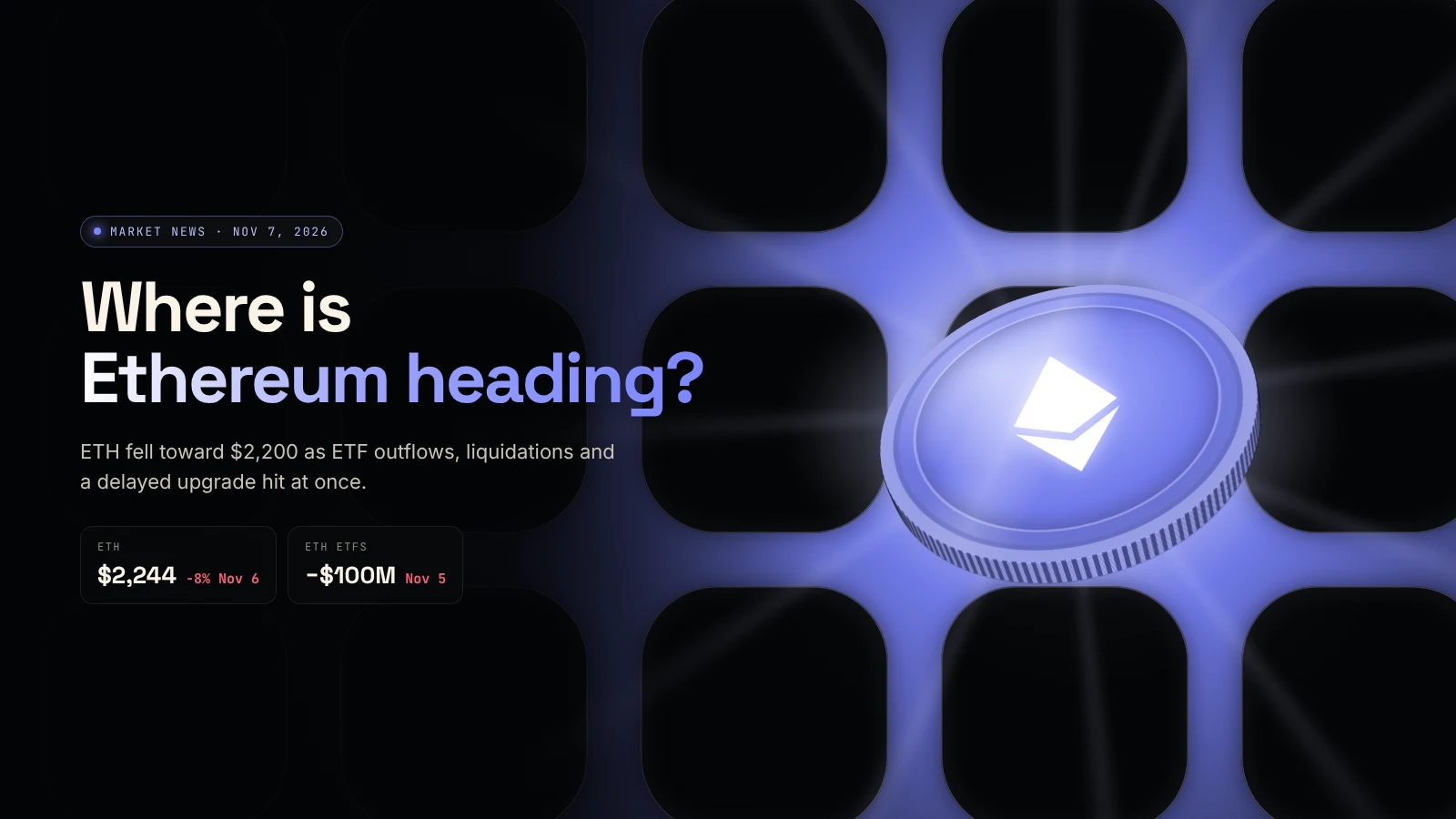
Ethereum is down because money left Ether ETFs, leveraged ETH bets were force-closed and developers delayed the next upgrade, all in the same week as a wider market sell-off. ETH fell more than 8% on November 6, 2026, toward $2,200, and was near $2,240 on November 7.
Why did money leave Ether ETFs?
Spot Ether ETFs let investors hold ETH through a normal brokerage account. When they sell, the funds sell ETH.
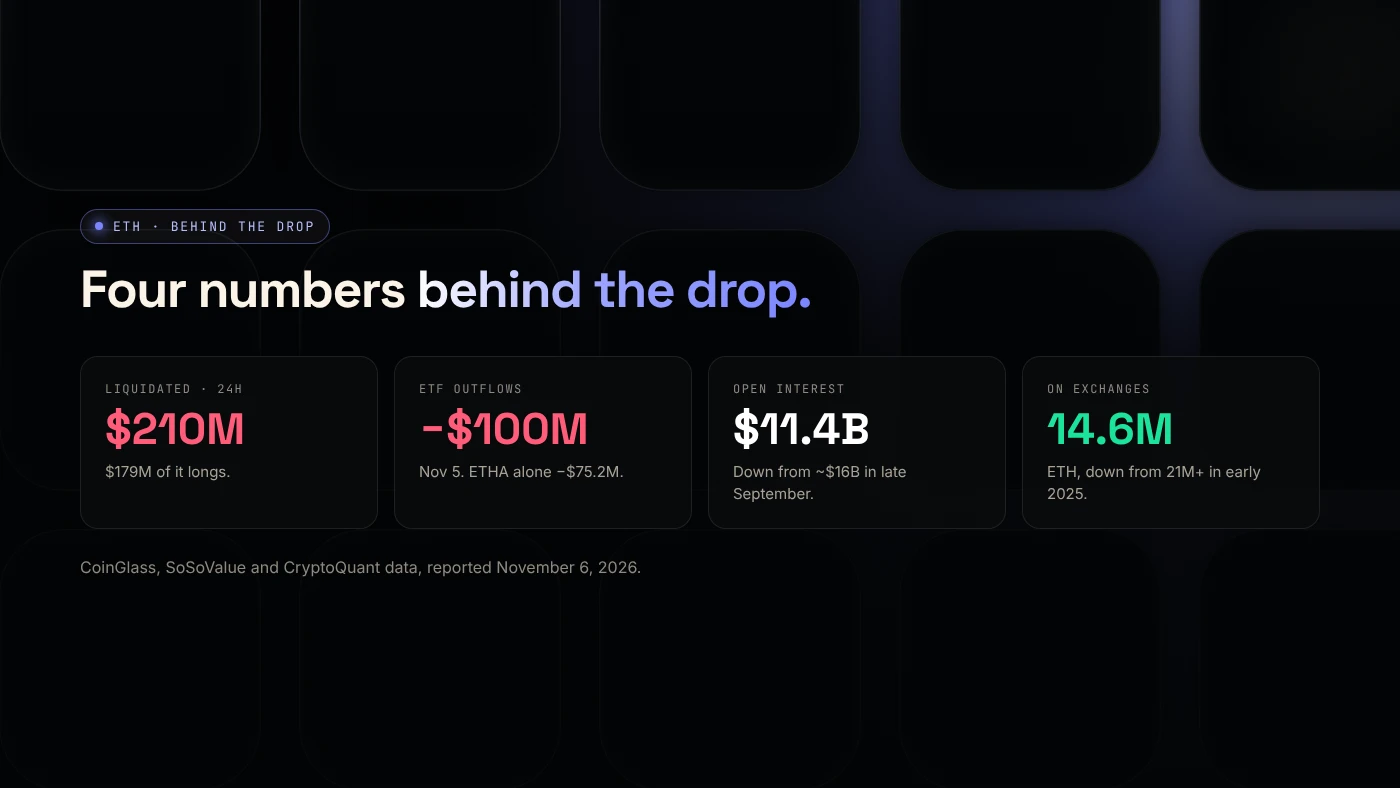
On November 5, the funds had net outflows of nearly $100 million. BlackRock's ETHA lost $75.2 million, 21Shares' ETHB $22 million, Fidelity's FETH $2.2 million and Grayscale's ETHE $0.5 million, according to SoSoValue data cited by crypto.news. Earlier in the week the funds lost $139.7 million on November 2 and $85.3 million on November 3, then gained $53 million on November 4.
Another $93.3 million left on the next session (KuCoin News). The outflows came as tech stocks fell and investors cut risk across the board. Our crypto crash explainer covers that wider picture.
How did liquidations push ETH lower?
Traders who borrowed to bet on ETH rising had their positions closed automatically as the price fell. More than $210 million of ETH positions were liquidated in 24 hours on November 6, $179 million of them longs (bets on a rise). Each forced sale pushed the price lower and triggered the next.
Open interest, the total size of open ETH futures bets, fell to about $11.4 billion, down from about $16 billion in late September. Less open interest means less leverage is left to unwind.
Our guide to crypto liquidations explains the mechanism in plain terms.
What is the Glamsterdam delay?
Glamsterdam is the next planned Ethereum network upgrade. On November 6, the Ethereum Foundation said developers would delay its activation on the Hoodi test network.
The reason was a finding by the security firm ChainSecurity. Two proposed changes to how gas is counted, EIP-8037 and EIP-8038, could break eight assumptions that existing smart contracts rely on. Developers are reviewing the changes with ChainSecurity and Dedaub. No new date has been set, and work on the following upgrade, Hegota, continues (KuCoin News).
A delay found by a security review is a normal part of upgrade work. It added to negative sentiment in a week that was already weak.
Which ETH price levels are analysts watching?
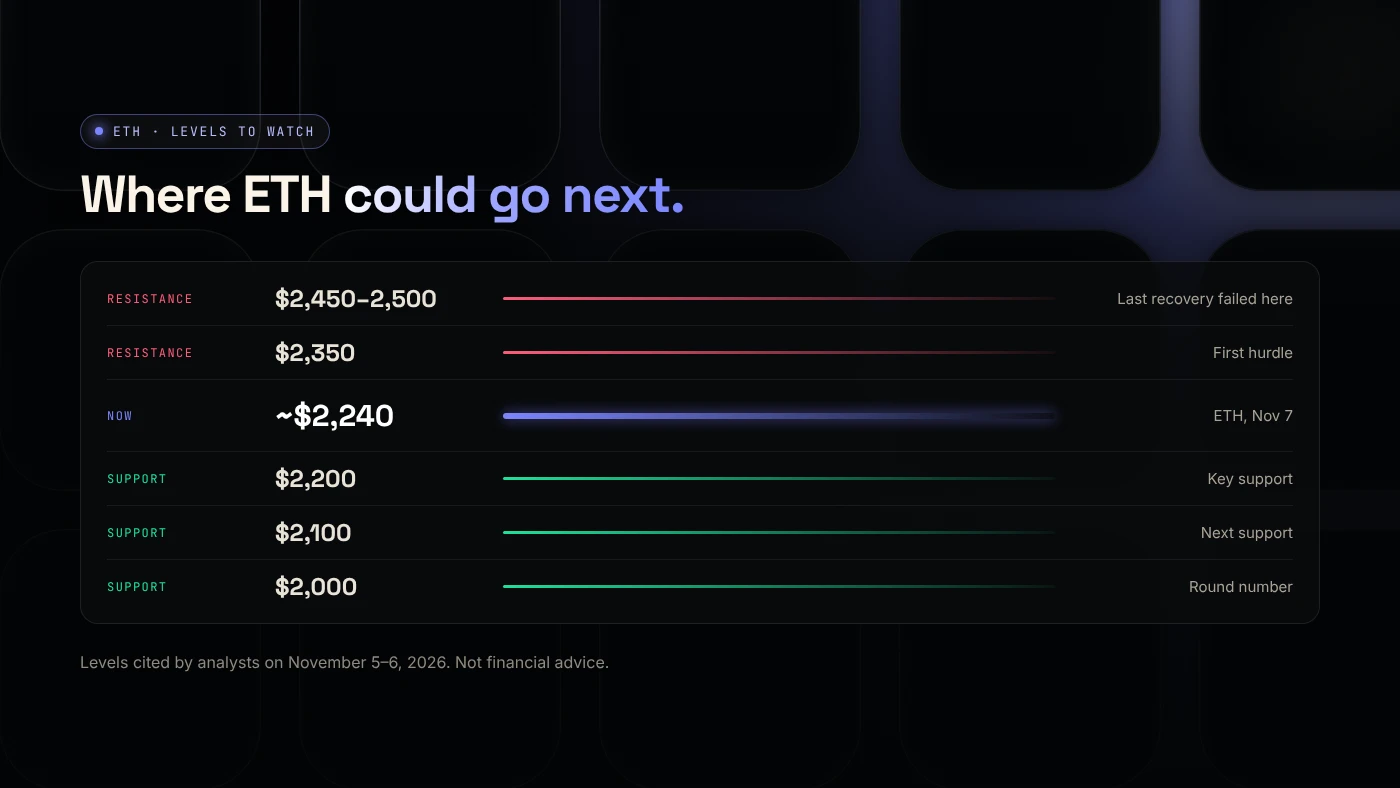
These are levels where buyers or sellers have shown up before, as cited by crypto.news on November 6, 2026. They are not targets.
- Support: about $2,200 first, then $2,100 and $2,000.
- Resistance: about $2,350, then the $2,450–$2,500 zone, where the last recovery attempt stalled.
- Momentum: the daily RSI, a 0–100 measure of recent buying and selling strength, was about 38. That is below neutral but not oversold.
One data point leans the other way. ETH held on centralized exchanges was about 14.6 million, down from more than 21 million in early 2025, according to CryptoQuant data. Fewer coins on exchanges means fewer coins ready to sell quickly.
What does a lower ETH price mean for creators?
Gas on Ethereum is paid in ETH, so the same transaction costs fewer dollars when ETH is cheaper. Creating an ERC-20 token or adding liquidity costs less in dollar terms than a month ago. Our guide to Ethereum gas fees explains how the cost is calculated.
The trade-off is a quieter market. Fewer buyers watch new tokens, and pools paired with ETH lose dollar value when ETH falls. See how to create an ERC-20 token if you want to prepare now and launch later.
What are the risks?
- Further drops. If $2,200 fails, analysts point to $2,100 and $2,000. Prices can move several percent in a day.
- Leverage. A 10x position is wiped out by roughly a 10% move against it.
- Pair exposure. A token paired with ETH falls in dollar terms when ETH falls.
- Upgrade timing. Glamsterdam has no new date, so plans that depend on it may need to wait.
You can lose money in crypto. This is not financial advice.
FAQ
Why is Ethereum going down?
ETF outflows, forced selling of leveraged ETH bets and a tech-stock sell-off all hit in early November 2026. The Glamsterdam delay added to the negative mood.
Why is Ethereum down today?
On November 6, 2026, ETH fell more than 8% as Asian stock markets dropped and the Glamsterdam test-network activation was delayed. More than $210 million of ETH positions were liquidated in 24 hours.
Can Ethereum go down to zero?
As far as we know, no analyst source used here suggests that. Ethereum is the second-largest crypto network, but ETH's price can still fall a long way, as it has from its 2025 high.
Sources
- crypto.news: Why is Ethereum price down today
- KuCoin News: Ethereum drops amid Glamsterdam delay
- KuCoin News: Bitcoin ETF outflow, Ethereum ETF loses $93.3M
- The Currency Analytics: Crypto market cap slides to $2.58T
When you are ready to build on Ethereum, the DegenKit Ethereum launcher creates a fixed-supply ERC-20 from your own wallet.