Ethereum Gas Fees Explained for Token Creators
Gas, gwei, base fee and priority fee decide what a transaction costs on Ethereum. Learn how the fee is calculated, why it changes and how to read your wallet's estimate.
 DegenKitOctober 30, 2026 · 4 min read
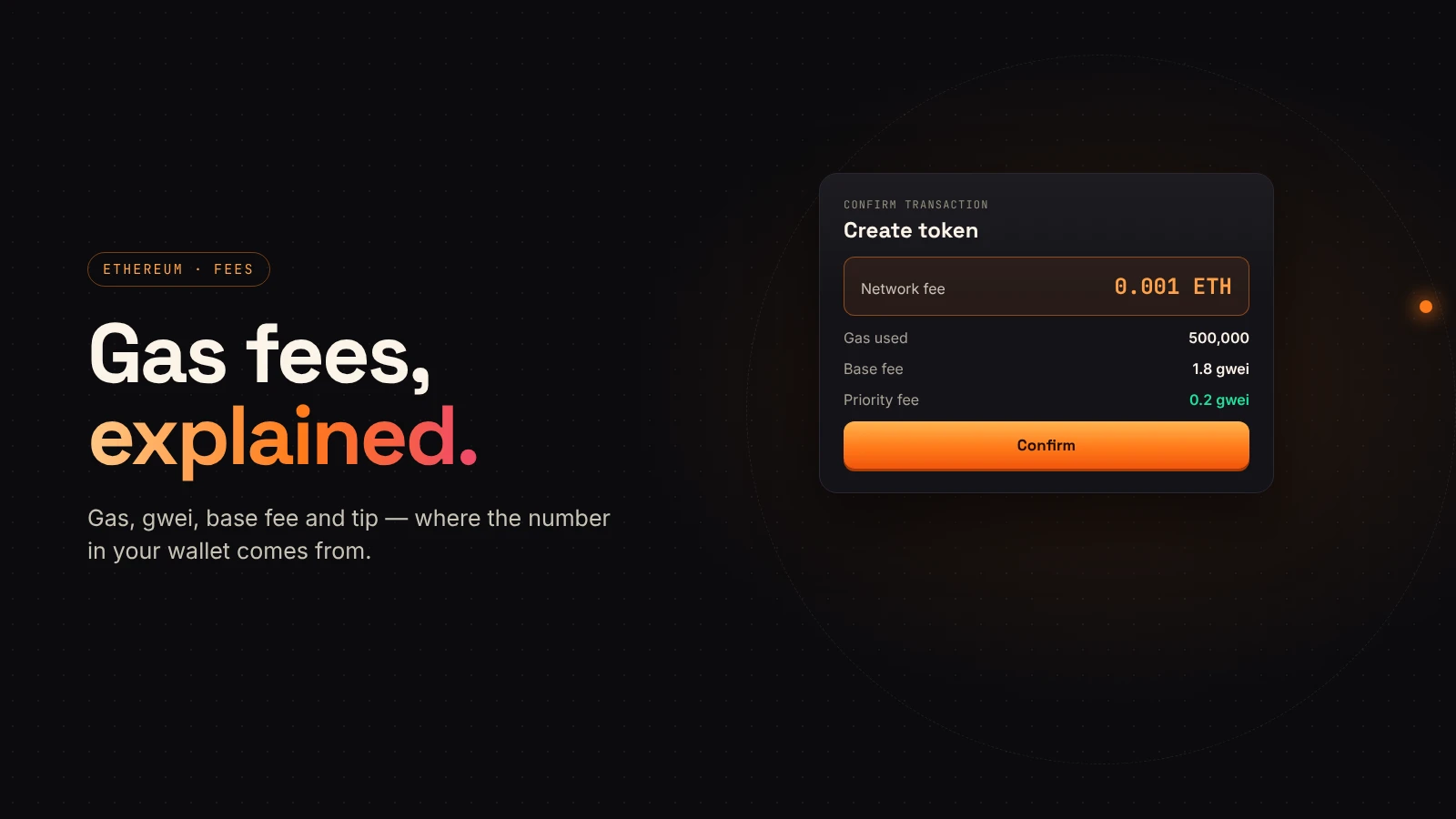
Every transaction on Ethereum pays a network fee, called gas. For a token creator, gas is part of the cost of creating the token, adding liquidity, setting approvals and managing a tax token. It is also the part that changes the most.
This guide explains where the number in your wallet comes from.
Gas is a unit of work
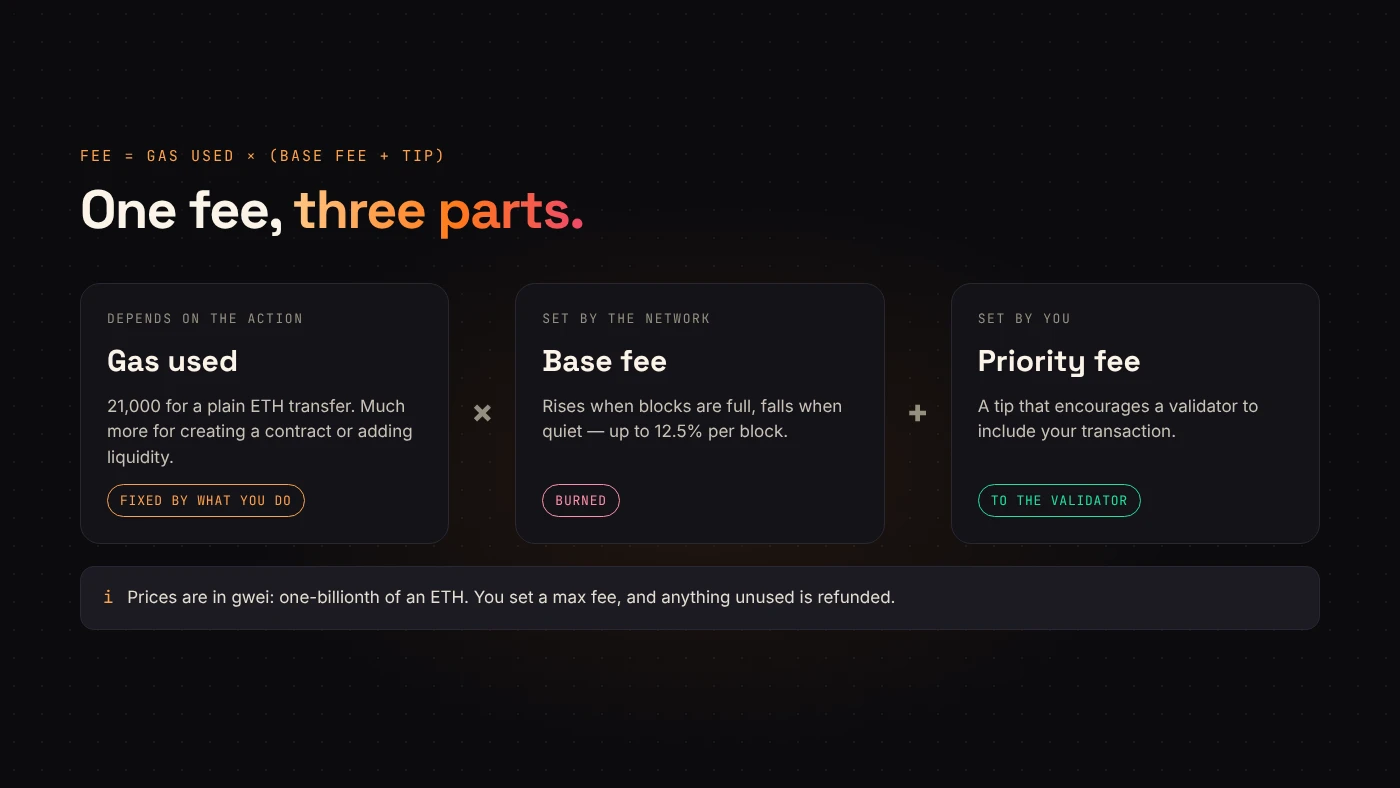
Ethereum's documentation describes gas as the unit that measures the computational effort an operation needs. Simple actions use little gas. A plain ETH transfer uses exactly 21,000 gas. Creating a contract or adding liquidity uses much more.
The price of each unit of gas is quoted in gwei. One gwei is one-billionth of an ETH.
The fee formula
Ethereum's docs give the formula:
fee = gas used × (base fee + priority fee)
- Base fee is set by the network for each block. It rises when blocks are busy and falls when they are quiet, by up to 12.5% per block. The base fee is burned, not paid to anyone.
- Priority fee, or tip, goes to the validator and encourages them to include your transaction.
Your wallet also sets a max fee. If the actual base fee plus tip comes in lower, you are refunded the difference.
A worked example
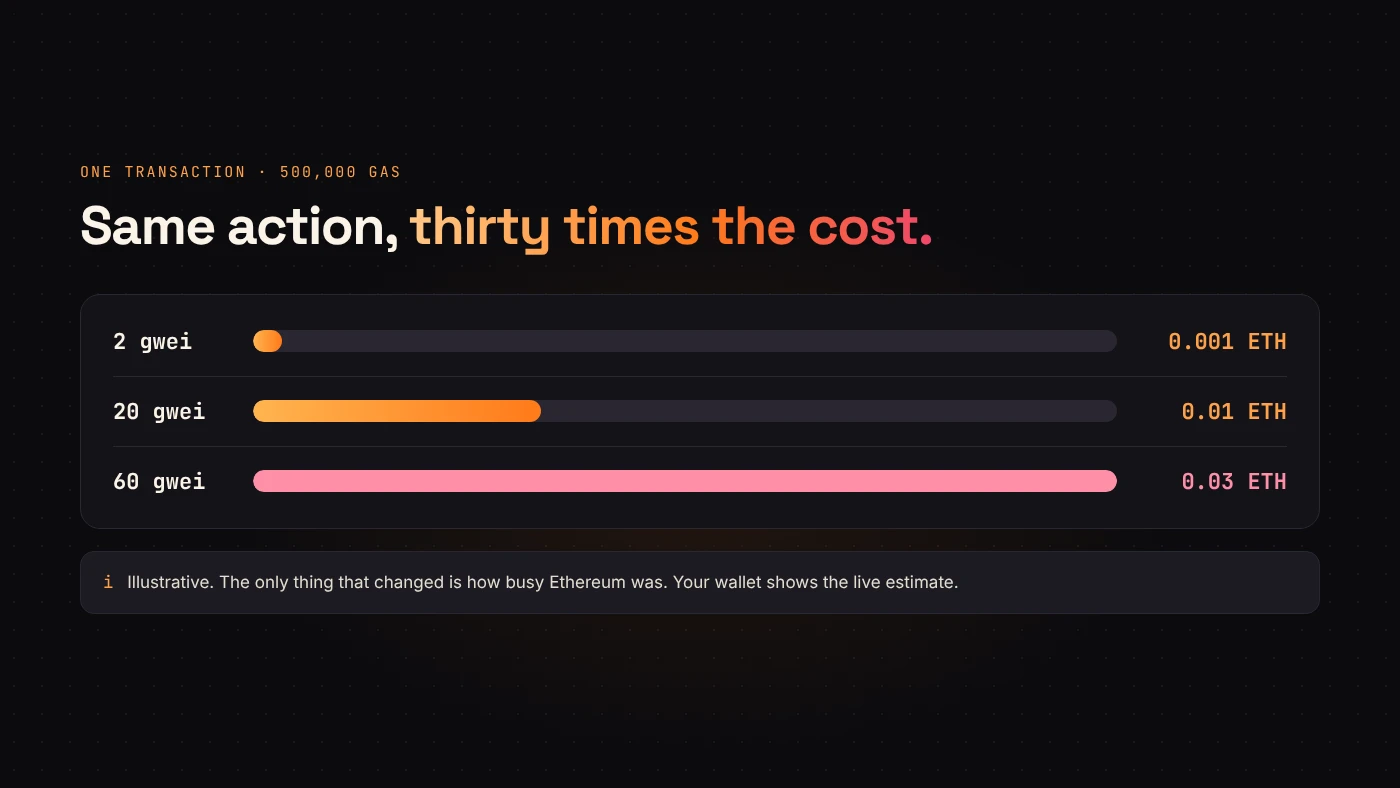
Suppose a contract interaction uses 500,000 gas. The numbers below are illustrative.
- At 2 gwei (base fee plus tip), the fee is 500,000 × 2 gwei = 1,000,000 gwei = 0.001 ETH.
- At 20 gwei, the same action costs 0.01 ETH.
- At 60 gwei, it costs 0.03 ETH.
Same action, thirty times the cost. The only difference is how busy Ethereum was.
Why your fee changes before you sign
Because the base fee moves with every block, the estimate in your wallet can change while you look at it. That is normal. A higher max fee gives your transaction more room if the base fee rises; you only pay what is actually needed, up to that max.
Gas in a token launch
A typical Ethereum launch involves several transactions, each with its own gas:
- Creating the token. One transaction. DegenKit also shows its own service fee before you sign; that is separate from gas.
- Approving the DEX to use your tokens when you add liquidity.
- Adding liquidity.
- For a tax token, marking the pool and any later changes to rates or ownership.
Questions people ask
Can I make a transaction cheaper?
You can wait for a quieter time, since the base fee falls when blocks are less full. Lowering the max fee too far only makes the transaction wait or fail.
Why do Layer 2 networks cost less?
Networks such as Robinhood Chain process transactions on their own chain and settle to Ethereum in batches, so each transaction pays much less. Our comparison of Ethereum and Robinhood Chain explains the trade-offs.
Wrap up
An Ethereum fee is gas used multiplied by the base fee plus a tip. Gas used depends on the action; the price depends on how busy the network is. Check the estimate in your wallet, keep ETH for every step, and open the Ethereum launcher when the timing suits you.